Every thirty seconds, somewhere in the world, a person dies from an infection that antibiotics can no longer stop. The numbers are staggering, the trajectory alarming, and the silence from the world's largest pharmaceutical companies deafening. The World Health Organization has called antimicrobial resistance one of the greatest threats to global health, yet the pipeline of new drugs grows thinner each year 26. Into this widening void, a new breed of biotech startup is stepping forward — armed with artificial intelligence, bacteriophages, and radical new science — determined to win a war that the industry's giants have quietly abandoned.
A Crisis Written in Numbers
The scale of the antimicrobial resistance (AMR) crisis is almost too vast to comprehend, but the data forces the reckoning. According to the World Health Organization, antibiotic-resistant infections have surged by 40 percent in recent years, a jump so steep it has rattled public health officials on every continent 5. The CDC estimates that more than 2.8 million antibiotic-resistant infections occur in the United States alone each year 28. Globally, the burden is catastrophic — and worsening. Drug-resistant pathogens now claim more lives annually than HIV/AIDS and malaria combined, and projections suggest that figure could rise to 10 million deaths per year by 2050 if the trajectory is not reversed 27.
What makes the crisis particularly insidious is its invisibility. Unlike a pandemic that shuts down airports and dominates front pages, AMR kills quietly — in hospital wards, in neonatal units, in the bodies of patients recovering from routine surgeries whose infections simply refuse to respond to treatment. Gram-negative bacteria, in particular, have proven exceptionally difficult to combat, developing resistance mechanisms at a rate that outpaces nearly every therapeutic advance 3.
The economic dimension compounds the human toll. The global antibiotic resistance market was valued at USD 8.45 billion in 2025 and is projected to grow to USD 9.12 billion in 2026, a figure that reflects not prosperity but the mounting cost of managing a crisis in the absence of cures 8. Research published in Nature underscores the economic and regulatory barriers that have long stifled antibiotic development, particularly the brutal commercial reality that antibiotics — by design — are used sparingly, making them far less profitable than drugs taken daily for chronic conditions 3.
The consequence of that commercial calculus has been a mass exodus. Large pharmaceutical companies have retreated from antibiotic research in droves, chasing more lucrative therapeutic areas. According to STAT News, the number of potential antimicrobial treatments being developed by the world's largest drugmakers plummeted by 35 percent — from 92 to just 60 active programs 10. That retreat has created a vacuum. And into that vacuum, startups are rushing.

""The next great antibiotic might not come from a corner office in Basel — it might come from a twelve-person team working out of a converted warehouse in Cambridge.""
The Innovators Filling the Void

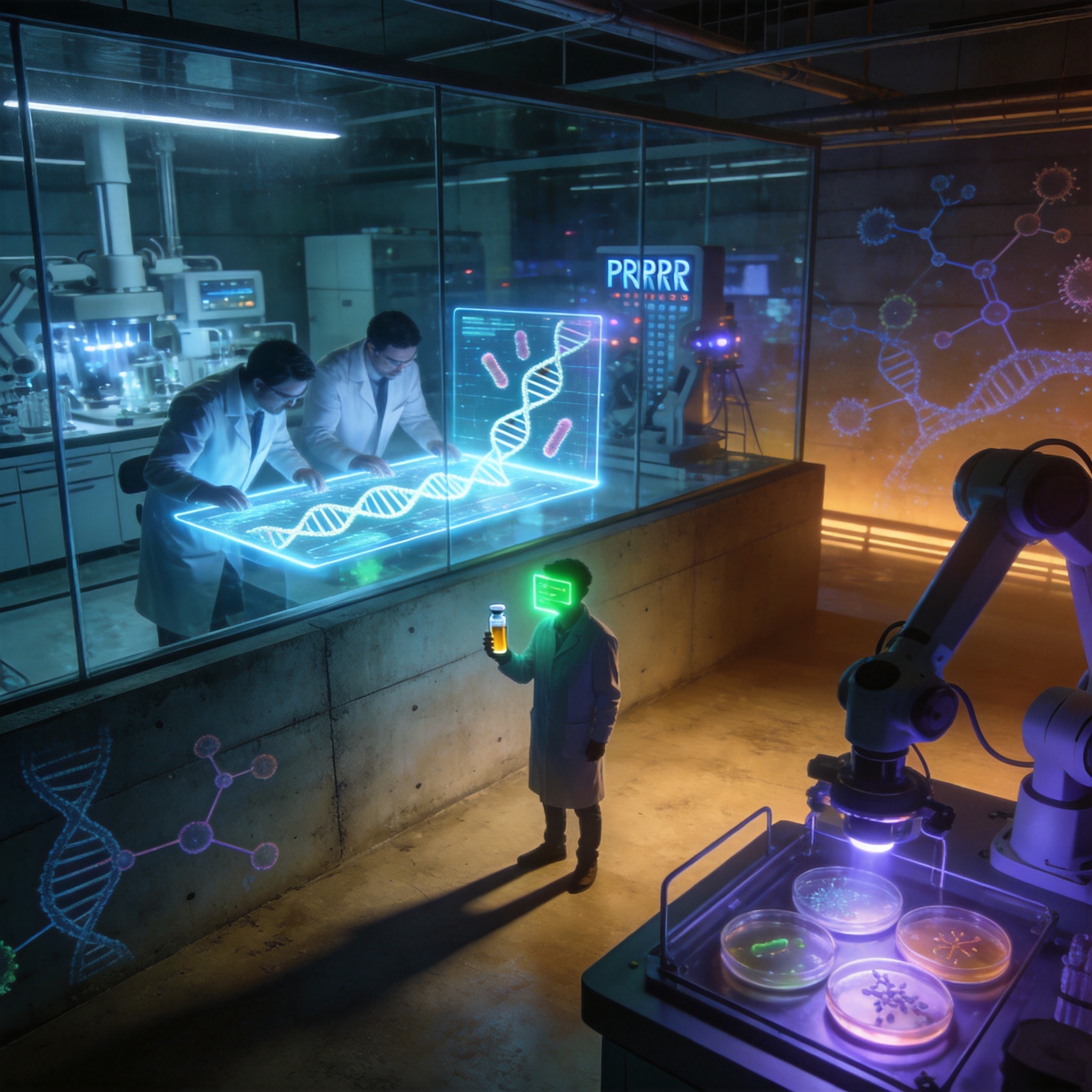
Where Big Pharma stepped back, a scrappier, more inventive cohort stepped forward. Across university campuses, venture-backed laboratories, and purpose-built research parks, biotech startups are developing approaches to AMR that are fundamentally different from anything that came before — not incremental improvements on existing antibiotics, but genuinely new mechanisms of attack.
TAXIS Pharmaceuticals has emerged as one of the most closely watched names in this space. The company's approach centers on discovering new molecular targets within bacteria — not merely reformulating existing drug classes, but identifying vulnerabilities that resistant organisms have never been forced to defend against 4. The 2026 AMR Benchmark, published by the Access to Medicine Foundation and supported by Wellcome, specifically identified companies like TAXIS as representative of the kind of innovative, late-stage progress the sector desperately needs 1. The report evaluated 25 pharmaceutical companies and found that while the overall pipeline remains worryingly thin, seven innovative late-stage projects are targeting some of the deadliest drug-resistant pathogens — a slender but meaningful source of hope 6.
Phage therapy — the use of bacteriophages, viruses that naturally prey on bacteria — is another frontier generating extraordinary scientific excitement. Startups in the United States and Europe are developing phage-based treatments that can be customized to target specific bacterial strains with surgical precision, sidestepping the collateral damage that broad-spectrum antibiotics inflict on the human microbiome. Unlike antibiotics, phages co-evolve with their bacterial hosts, meaning resistance, while possible, is far harder to sustain 13.
Artificial intelligence is accelerating the pace of discovery in ways that would have seemed implausible a decade ago. AI platforms can now screen millions of molecular compounds in the time it once took researchers to analyze hundreds, identifying promising antibiotic candidates with a speed and accuracy that fundamentally changes the economics of early-stage drug discovery 15. Several startups profiled in a 2026 analysis of emerging biotech trends are deploying machine learning not just to find new drugs, but to predict which bacterial mutations are most likely to emerge — allowing researchers to design antibiotics that are, in effect, resistance-resistant 7.
""Seven late-stage projects offer cautious optimism in a landscape otherwise defined by retreat, underfunding, and the quiet arithmetic of preventable death.""
The Business of Saving Lives
Brilliant science is only half the battle. The other half — the part that has broken countless promising companies before — is economics. Building a new antibiotic from scratch costs hundreds of millions of dollars and takes more than a decade. If it succeeds, it is prescribed as a last resort, used sparingly, and priced conservatively to prevent overuse. The financial return barely covers the investment. That equation has driven every major pharmaceutical company away from the field, and it threatens to do the same to the startups now filling the gap 3.
The challenge is not lost on policymakers. In the United States and Europe, legislators have explored so-called "pull incentives" — financial rewards paid to developers when a drug reaches the market and meets a defined public health need, decoupled from the volume of prescriptions written. The UK's subscription-style payment model, which pays antibiotic developers a fixed annual fee regardless of how many doses are dispensed, has been cited as a potential global template 12. But implementation has been slow, and the funding remains inadequate relative to the scale of the problem.
Boston University-based nonprofit CARB-X has stepped into this space, providing early-stage funding and support to AMR-focused startups that would otherwise struggle to attract traditional venture capital 5. The organization's model — backing high-risk, high-impact science at the stage where commercial investors fear to tread — has helped dozens of companies survive the brutal early years of drug development.
Forbes has noted the broader boom in biotech startups, driven by falling costs of genetic sequencing, advances in synthetic biology, and a new generation of founders trained at the intersection of biology and data science 20. AMR-focused companies are benefiting from that tailwind, attracting a wave of mission-driven investors who recognize that the next great antibiotic might not come from a corner office in Basel or New Jersey — it might come from a twelve-person team working out of a converted warehouse in Cambridge or San Diego.

""Startups racing to solve AMR are not just developing drugs — they are making a bet on science, on policy, and on humanity's capacity to act before the window closes entirely.""
Turning the Tide — or Running Out of Time
The 2026 AMR Benchmark, released by the Access to Medicine Foundation, offers what its authors describe as "pockets of progress" — a phrase that is simultaneously encouraging and sobering 1. Seven late-stage projects. Seven reasons for cautious optimism in a landscape otherwise defined by retreat and underfunding. The report acknowledges that some companies are demonstrating the tide can be turned, but stresses that industry-wide action — not isolated heroism — is what the moment demands 1.
The scientific community is increasingly vocal about the urgency. A review published in Frontiers in Microbiology highlights the critical importance of antimicrobial stewardship alongside new drug development — ensuring that whatever new antibiotics do reach the market are deployed wisely, rationed carefully, and not squandered within a decade of launch 17. Researchers published in the National Institutes of Health's PMC database emphasize that awareness campaigns, regulatory reform, and international coordination must accompany the laboratory breakthroughs to produce lasting change 2.
The environmental dimension of AMR adds yet another layer of complexity. Antibiotics entering waterways through agricultural runoff and pharmaceutical manufacturing waste are accelerating resistance in environmental bacteria, creating a reservoir of resistant genes that can transfer to human pathogens 19. Startups working on AMR cannot simply focus on the clinic; the problem bleeds into ecosystems, supply chains, and food systems in ways that demand solutions beyond the pill bottle.
IFPMA, the International Federation of Pharmaceutical Manufacturers and Associations, has published projections for what a revitalized antibiotic pipeline could look like — one built on public-private partnerships, reformed intellectual property frameworks, and sustained political will 23. The vision is achievable. The question is whether the will exists to fund it, sustain it, and reward the companies brave enough to pursue it.
The startups racing to solve AMR are not just developing drugs. They are making a bet — on science, on policy, on humanity's capacity to act before the window closes entirely. History will not be kind to the generation that had the tools, understood the threat, and still chose to look away.
---