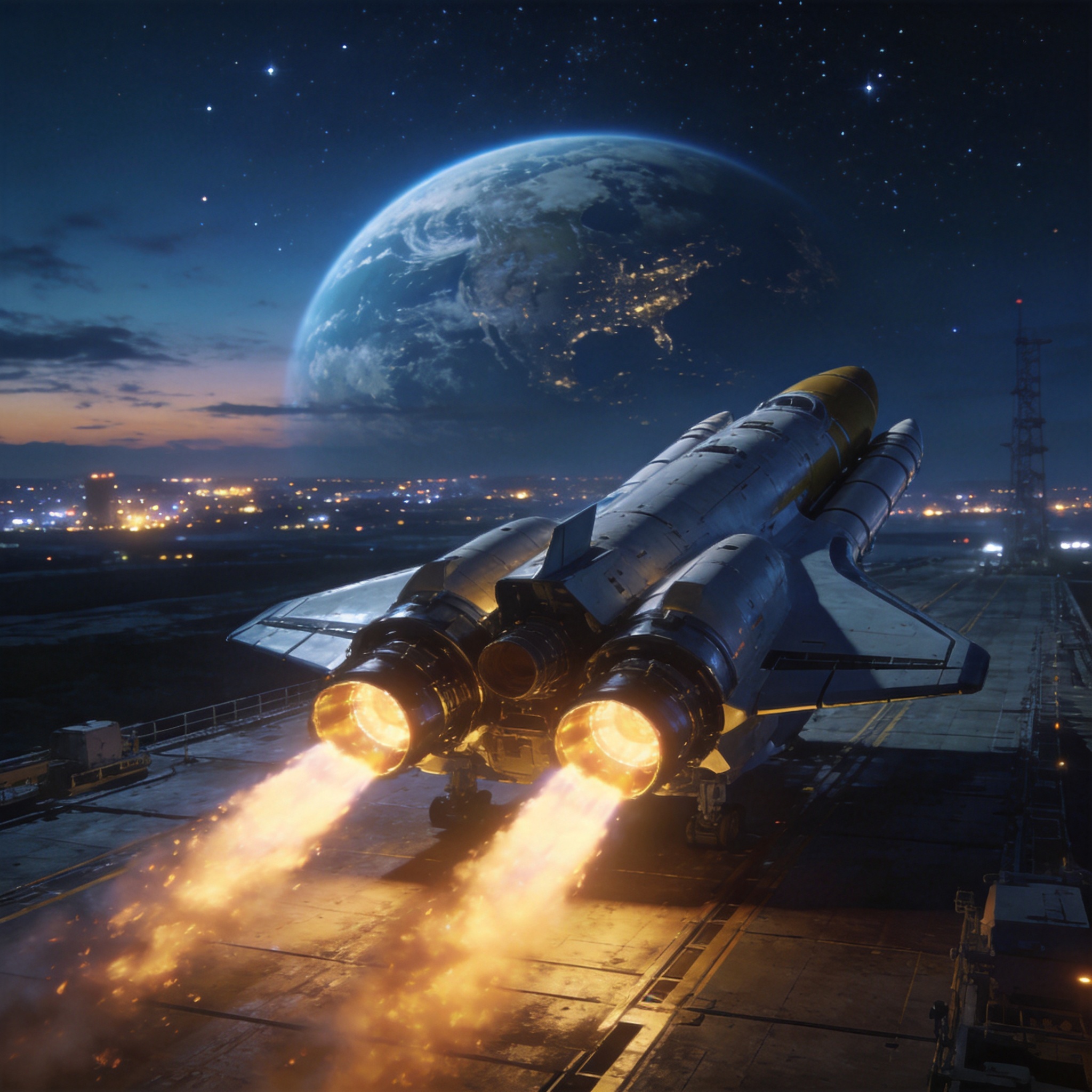
Humanity's Bold, Breathtaking Return to the Stars
After fifty years of silence, a new space race is rewriting history — and this time, everyone wants a seat on the rocket.
By AI Magazine Writer
The countdown clock doesn't lie. Somewhere deep inside NASA's Kennedy Space Center in Florida, a number ticks steadily downward toward a moment that will redefine what it means to be human in the twenty-first century. For the first time in more than fifty years, astronauts are preparing to leave the safe, familiar cradle of low-Earth orbit and venture outward — past the invisible boundary where the sky surrenders to stars. The new space race has begun, and unlike the Cold War sprint that first carried humanity to the moon, this one is crowded, complicated, and more consequential than ever before.
One Giant Leap, Fifty Years in the Making
It started with silence. After Apollo 17's Gene Cernan stepped off the lunar surface in December 1972 and climbed back into his lunar module, no human being followed him. For half a century, the moon sat patient and unreachable, bathed in silver light, waiting. Now, finally, the wait appears to be over.
NASA's Artemis program represents the agency's most ambitious undertaking since the original Apollo era, and 2026 has emerged as the year that ambition crystallizes into reality 1. After a frustrating cascade of delays, evolving mission frameworks, and technical setbacks that stretched timelines well beyond original projections, NASA is positioning itself for a genuine return to crewed lunar exploration 1. The Artemis II mission — NASA's first crewed flight under the program — is targeted to carry four astronauts on a ten-day voyage around the Moon inside the Orion spacecraft, launching no earlier than March 6, 2026 4. It is not a landing, not yet, but it is something almost as profound: proof that the machinery works, that human beings can once again slip the bonds of Earth and arc outward into the dark.
In 2025, NASA stacked the Artemis II rocket, certified next-generation lunar spacesuits, and celebrated twenty-five years of continuous human presence aboard the International Space Station 3. These weren't small achievements. They were the architectural bones of something larger — a program designed not merely to plant a flag and come home, but to establish a sustained human presence on and around the moon. The Artemis vision, as NASA has articulated it, is a stepping stone: the moon first, then Mars.
What makes this moment different from the Apollo era is the sheer weight of expectation pressing down on it. Apollo was a geopolitical sprint, a binary competition between two superpowers racing to prove ideological supremacy. Artemis is something messier, more collaborative in some dimensions and more competitive in others. It carries the hopes of scientists who want to mine the secrets locked in lunar ice, engineers who see the moon as a refueling depot for deep space missions, and a generation of young people who grew up watching rockets land themselves on drone ships and dared to believe the impossible was merely expensive.
---
""The moon's south pole, with its potential water ice that could be converted into rocket fuel, drinking water, and oxygen, has become the most strategically valuable real estate in the solar system.""
Private Rockets and the Billionaire Frontier

If NASA represents the institutional heartbeat of the new space age, then the private sector is its restless, risk-tolerant nervous system. The transformation has been staggering. Where once a government monopoly controlled every bolt, every trajectory, and every dollar spent reaching orbit, today a sprawling ecosystem of private companies has fundamentally rewritten the economics and culture of space exploration 7.
SpaceX sits at the undeniable center of this revolution. The company founded by Elon Musk has, through sheer engineering audacity and a willingness to fail publicly and learn quickly, compressed the cost of reaching orbit by an order of magnitude 8. Its Falcon 9 rocket has become the workhorse of the modern launch industry, while the massive Starship vehicle — the most powerful rocket ever built — promises to carry humans to the moon and eventually Mars 11. SpaceX's involvement in Artemis is not peripheral; the company's Starship variant has been selected as NASA's Human Landing System, the vehicle that will actually touch down on the lunar surface during Artemis III 8.
But SpaceX is far from alone. NASA and the private space company Vast have signed an order for the sixth private astronaut mission to the International Space Station, targeted to launch no earlier than summer 2027 2. Blue Origin, founded by Amazon's Jeff Bezos, is developing its own lunar lander and heavy-lift rocket. Rocket Lab, Relativity Space, and dozens of other startups are competing for launch contracts, satellite deployment, and a piece of the lunar economy that analysts believe could be worth hundreds of billions of dollars within decades 17.
The George Washington University's Space Policy Institute has tracked this shift with careful attention, noting that today there are more than a thousand active satellites in orbit operated by private entities — a number that would have seemed fantastical as recently as 2010 7. The implications ripple outward in every direction. Launch costs have plummeted. Mission cadences have accelerated. And the definition of who gets to participate in space exploration has expanded dramatically, even if full democratization remains a distant, aspirational horizon.
This privatization of the cosmos is not without its critics. Questions about regulation, environmental impact, orbital debris, and the concentration of space infrastructure in the hands of a few extraordinarily wealthy individuals have grown louder alongside the rocket exhaust. But for now, the momentum is undeniable and the launches keep coming.
---
""Two competing visions of the lunar future are taking shape simultaneously, and the decisions made in the next decade will determine which one prevails — or whether some uneasy coexistence becomes the permanent condition of humanity in space.""
The Geopolitical Chessboard Above the Clouds
Not everyone racing toward the moon is doing so in partnership with NASA. The new space race carries unmistakable geopolitical undertones, and nowhere is that tension more visible than in the competition for the lunar south pole — a region of craters and permanent shadow that scientists believe conceals vast deposits of water ice 13.
China has made no secret of its lunar ambitions. The China National Space Administration has outlined plans for crewed lunar landings before 2030, and its robotic Chang'e missions have already demonstrated impressive technical capability. India, energized by the historic success of Chandrayaan-3's south pole landing in 2023, is planning follow-up missions with increasing sophistication 13. Russia, Japan, and the European Space Agency are all positioning their own pieces on this celestial chessboard. The moon's south pole, with its potential water ice that could be converted into rocket fuel, drinking water, and oxygen, has become the most strategically valuable real estate in the solar system 13.
The Guardian, in a December 2025 editorial, warned bluntly that humanity risks exporting its old politics to the moon — that a new dash across the skies was reigniting geopolitical competition under the thin guise of peaceful exploration. The concern is legitimate and historically grounded. Resources have always attracted rivalry, and space, for all its romance, is not immune to the oldest human instincts.
The Artemis Accords, a set of bilateral agreements championed by NASA and signed by dozens of nations, represent one attempt to establish norms of behavior in this new frontier 8. They address transparency, interoperability, and the peaceful use of space resources. But China and Russia have declined to sign, preferring instead to develop their own International Lunar Research Station project. Two competing visions of the lunar future are taking shape simultaneously, and the decisions made in the next decade will determine which one prevails — or whether some uneasy coexistence becomes the permanent condition of humanity in space.
The stakes feel enormous precisely because they are. Whoever controls access to lunar water ice controls, in a very real sense, the economics of the entire inner solar system.
---
""The stars have not changed. Only our reach has.""
Eyes on the Universe: Science at the Edge of Everything
Beyond the geopolitics and the billionaire rivalries, the new space age is delivering something quieter and more profound: a revolution in human knowledge. The scientific instruments being launched into space in 2026 and beyond represent a generational leap in our capacity to understand the universe and our place within it.
NASA's Nancy Grace Roman Space Telescope is among the most anticipated scientific instruments in decades. During its five-year primary mission, Roman is expected to discover more than 100,000 distant exoplanets and map billions of galaxies strewn across the observable universe 5. To put that number in perspective: the total count of confirmed exoplanets before the Kepler Space Telescope launched in 2009 was fewer than 400. Roman will dwarf that legacy in a fraction of the time, reshaping our understanding of planetary formation, galactic structure, and the cosmic conditions that might support life elsewhere.
The James Webb Space Telescope, now well into its operational life, continues to send back images that routinely shatter previous assumptions about the early universe. It has detected galaxies forming at a pace and scale that existing cosmological models struggled to predict, forcing theorists back to their equations with fresh urgency 5. Webb and Roman together represent a one-two punch of observational power that astronomers have dreamed about for generations.
Closer to home, lunar science stands on the verge of a renaissance. The Artemis missions will carry scientific instruments designed to study the moon's geology, its exosphere, and the behavior of materials in the lunar environment over long periods 4. The data gathered will inform not just lunar science but the broader project of understanding how rocky planets form and evolve — including our own.
And then there is the human dimension that no instrument can fully capture. Every launch, every orbit, every bootprint in regolith carries within it the accumulated weight of human curiosity — the same impulse that drove our ancestors across oceans and over mountain ranges, always wondering what lay beyond the next horizon. The stars have not changed. Only our reach has.
The universe, patient and indifferent for thirteen billion years, is finally being asked to give up its secrets. And this time, we intend to stay.
---