Starship Rising: Humanity's Giant Leap Begins Now
SpaceX's colossal Starship rocket is rewriting the rules of space exploration, one test flight at a time.
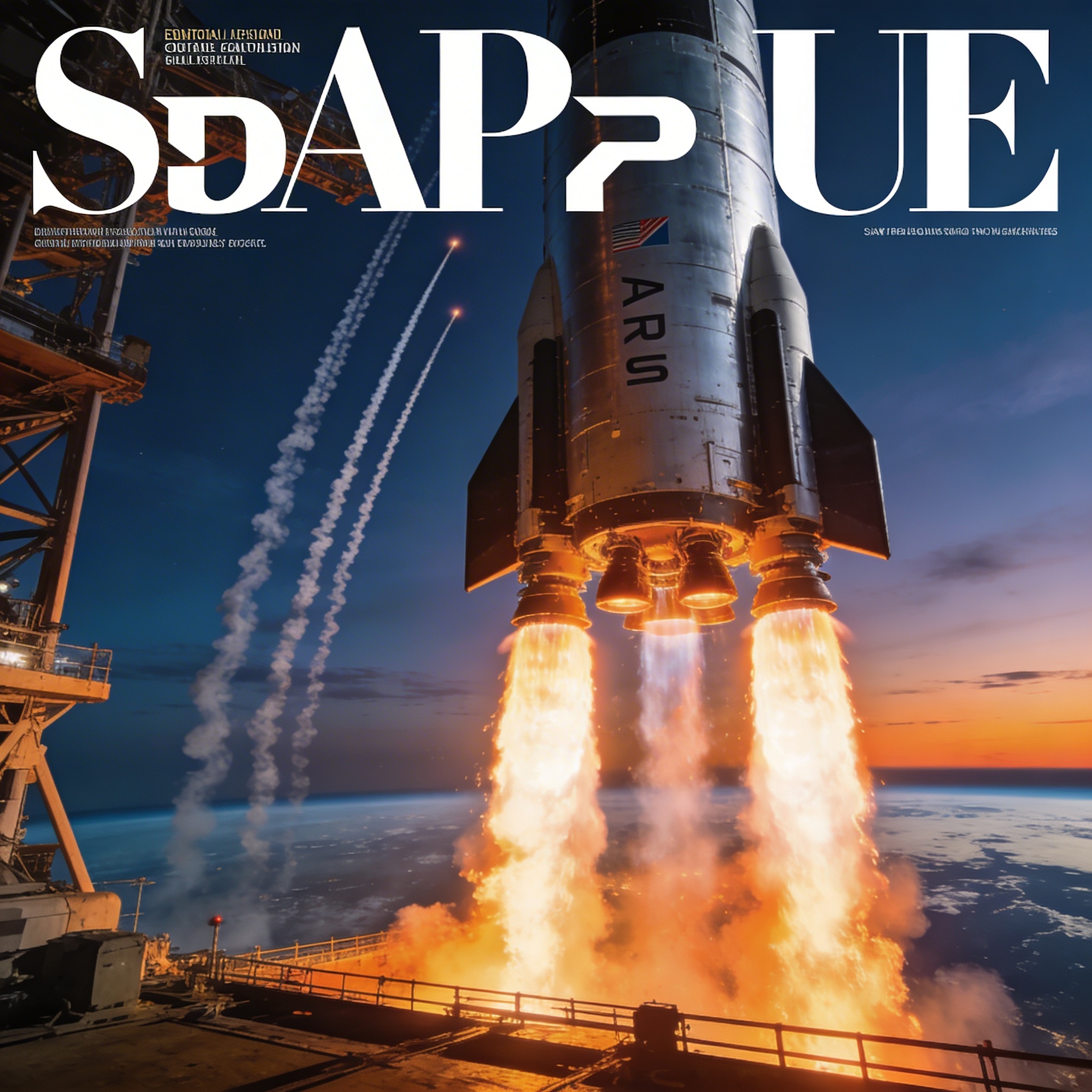
There is a moment — brief, electric, almost theological — when a rocket the size of a 40-story building lifts off the Texas coast and punches through the atmosphere with enough thrust to rearrange your understanding of what is possible. That moment has been happening with increasing regularity along the Gulf Coast of South Texas. SpaceX's Starship, the most powerful launch vehicle ever constructed, is no longer just a promise scrawled on a whiteboard in Hawthorne, California. It is a machine in motion, and the era it is ushering in may be the most consequential chapter in the history of human spaceflight.
There is a moment — brief, electric, almost theological — when a rocket the size of a 40-story building lifts off the Texas coast and punches through the atmosphere with enough thrust to rearrange your understanding of what is possible. That moment has been happening with increasing regularity along the Gulf Coast of South Texas. SpaceX's Starship, the most powerful launch vehicle ever constructed, is no longer just a promise scrawled on a whiteboard in Hawthorne, California. It is a machine in motion, and the era it is ushering in may be the most consequential chapter in the history of human spaceflight.
The Machine That Changed the Math
To understand why Starship matters, you first have to understand the sheer scale of the problem it is solving. For decades, getting mass into orbit has been extraordinarily expensive and frustratingly limited. Even in 2025 — described by SpaceX itself as "the most prolific year in history in terms of the number of orbital launches" — only approximately 3,000 tons of payload was launched into orbit globally [1]. That number sounds impressive until you consider what humanity would actually need to build a permanent presence beyond Earth. Fuel depots. Habitat modules. Life support systems. The math has never worked — until now.
Starship is designed to carry up to 150 metric tons to low Earth orbit in a fully reusable configuration, a payload capacity that dwarfs every rocket that has come before it [24]. Its two-stage architecture — the Super Heavy booster and the Starship upper stage — is powered by a cluster of next-generation Raptor engines burning liquid methane and liquid oxygen, a propellant combination chosen specifically because both can theoretically be synthesized on Mars [21]. That is not an accident. Every engineering decision in Starship's design traces back to a single, audacious destination.
The year 2025 was a proving ground. SpaceX conducted five full-stack test flights over the course of the year, though only two of those flights resulted in the Starship upper stage successfully landing [4]. Progress was real, but uneven — a reminder that building the future is a messy, iterative business. By the time the 11th test flight concluded successfully in late 2025, Scientific American declared that SpaceX was standing "on the cusp of a new era in spaceflight" [6]. The 12th flight, featuring what Elon Musk described as the most powerful version of Starship yet, was being prepared for launch just weeks later [5]. The machine was learning. And so was the team building it.
What makes Starship structurally different from every rocket program that preceded it is the philosophy embedded in its bones: full and rapid reusability. The dramatic mechanical-arm "chopstick" catch of the Super Heavy booster — returning it to the launch tower rather than letting it splash into the ocean — became one of the defining images of 2025. It was, as the American Enterprise Institute observed, a moment that captured "the spirit of a new space age" [20]. The old model of expendable rockets, where billions of dollars in hardware were simply discarded after a single use, is being rendered obsolete in real time.
---

"Starship is not merely a rocket — it is a forcing function compelling the entire industry to reckon with a future arriving faster than anyone planned for."
A Year of Records, Risks, and Revelations

SpaceX did not arrive at Starship's current capabilities by accident. The company spent 2025 breaking records across every dimension of its operation. According to Space.com, SpaceX launched 170 times over the course of the year, including 165 Falcon 9 flights — a staggering cadence that no other launch provider on Earth comes close to matching [5]. That operational tempo is not just a commercial achievement. It is a training ground, a culture of execution that has made SpaceX the most experienced rocket company in human history by almost any metric [23].
But records can obscure the genuine difficulty of what SpaceX is attempting. The Starship program has never pretended to be risk-free. Three of the five full-stack test flights in 2025 ended without a successful Starship landing [4], meaning the program absorbed significant hardware losses even as it gathered invaluable flight data. This is the SpaceX methodology made visible: fly, fail, learn, iterate — faster than any government program would dare. It is an approach that makes aerospace traditionalists deeply uncomfortable, and it is also the reason Starship exists at all while its competitors remain on drawing boards.
Aviation Week reported that SpaceX was actively targeting the first launch of a new Starship Version 3 configuration in either late 2025 or early 2026 [8], signaling that the company's engineering pipeline runs well ahead of its current flight cadence. Meanwhile, NASASpaceFlight.com noted that 2026 was shaping up to be the year that "development compounds," with SpaceX simultaneously building out multiple launch sites to support future Starship operations [4]. The Florida launch complex at Kennedy Space Center, long the symbolic home of American human spaceflight, is being prepared to host Starship flights — a development that carries enormous symbolic and logistical weight [16].
The FAA, historically a source of friction for SpaceX's ambitious launch schedules, has been slowly adapting to the new reality. Environmental assessments for significantly increased annual Starship launch rates from the Boca Chica, Texas facility have been advancing through the regulatory pipeline [19], a sign that the agency is beginning to calibrate its processes to match the pace of the program it is overseeing. Whether that calibration happens fast enough to meet SpaceX's ambitions remains one of the central tensions of the moment.
---
"The old model of expendable rockets, where billions of dollars in hardware were simply discarded after a single use, is being rendered obsolete in real time."
The Moon, Mars, and the Commercial Calculus
NASA's Artemis program has had a complicated relationship with Starship, but the direction of travel is unmistakable. SpaceX has been selected to provide the Human Landing System that will return American astronauts to the lunar surface for the first time since 1972 — a contract that puts Starship at the absolute center of the United States' most ambitious human spaceflight program in a generation. Recent reporting confirmed that SpaceX has effectively displaced Boeing from a dominant role in the NASA Moon mission architecture [5], a seismic shift that would have seemed improbable a decade ago.
The technical demands of a lunar landing mission are formidable. Starship will need to demonstrate reliable in-space propellant transfer — the process of refueling the spacecraft in orbit before it departs for the Moon — before any crew can safely board it for a lunar journey. SpaceX's own updates page acknowledges that "thanks to advancements like in-space propellant transfer, Starship will be capable of landing massive amounts of cargo on the Moon" [1]. That capability is not yet fully demonstrated, but the roadmap is clear, and the company's trajectory in 2025 suggests it is closing the gap faster than many external observers expected.
Beyond the Moon, the commercial implications of a fully reusable heavy-lift rocket are staggering. Spherical Insights, in its analysis of the top space exploration trends for 2025, highlighted the transformative potential of reusable launch systems in dramatically reducing the cost of access to orbit [9]. Lower costs mean more satellites, more science missions, more commercial stations, and ultimately more people living and working in space. The investment community has taken notice. Reuters reported that the space sector was eyeing further investment growth in 2026 following a record year, with Starship's development trajectory cited as a key driver of investor confidence [22].
SpaceX has also publicly stated goals of reaching 25 annual Starship launches as a near-term operational target [11], a number that would represent a fundamental transformation of humanity's relationship with the space beyond our atmosphere. At that cadence, the economics of space change entirely. Payloads that were once the exclusive province of government agencies with billion-dollar budgets become accessible to universities, startups, and nations that have never launched anything at all.
---
"Strip away the spectacle, and what Starship represents is something more profound and more patient: the construction of a highway to the solar system."
The Longer Arc: What Starship Actually Means
Strip away the spectacle — the towering rocket, the mechanical arms, the social media countdowns — and what Starship represents is something more profound and more patient than any single launch. It is an infrastructure play. It is the construction of a highway to the solar system at a time when humanity has, for the first time in its history, both the technological capability and the arguably urgent motivation to become a multi-planetary species.
Elon Musk has never been shy about articulating that motivation. Mars is the destination. The entire Starship architecture — the methane propellant, the full reusability, the massive payload capacity, the in-space refueling capability — is engineered backward from the requirements of a crewed Mars mission [21]. Whether that mission happens in the 2030s or the 2040s or later still, the vehicle being tested today on the Texas coast is the vehicle that will, in some evolved form, carry the first humans to another planet. That is not marketing language. That is the engineering specification.
In the nearer term, 2026 is shaping up to be a decisive year. Payload Space's annual outlook identified Starship's development as the single most consequential variable in the space industry's trajectory for the year ahead [16]. The debut of a new Starship design, the continued build-out of the Florida launch facility, and the ongoing progression toward operational lunar missions are all converging in a timeline that feels, for the first time, genuinely imminent rather than perpetually aspirational. Nova Space's 2026 industry outlook similarly flagged Starship-related milestones as central to the year's most significant developments [16].
The broader space industry is being reshaped around Starship's existence. Competitors are accelerating their own heavy-lift programs. Launch customers are rethinking their satellite architectures to take advantage of larger fairing sizes. Governments are revising their space strategies. The satellite and space industry's own technology trend reports for 2026 identify reusable heavy-lift as a foundational shift that will ripple through every segment of the sector [18]. Starship is not merely a rocket. It is a forcing function — a machine that is compelling the entire industry to reckon with a future that is arriving faster than anyone planned for.
---
Sources & References 24
- spacex.com
- surfshark.com
- youtube.com
- nasaspaceflight.com
- space.com
- scientificamerican.com
- bit.ly
- aviationweek.com
- sphericalinsights.com
- payloadspace.com
- teslarati.com
- cnet.com
- flyingmag.com
- marcus
- keeptrack.space
- nova.space
- spaceexplored.com
- interactive.satellitetoday.com
- foxbusiness.com
- aei.org
- spaceref.com
- reuters.com
- spacexnow.com
- livescience.com