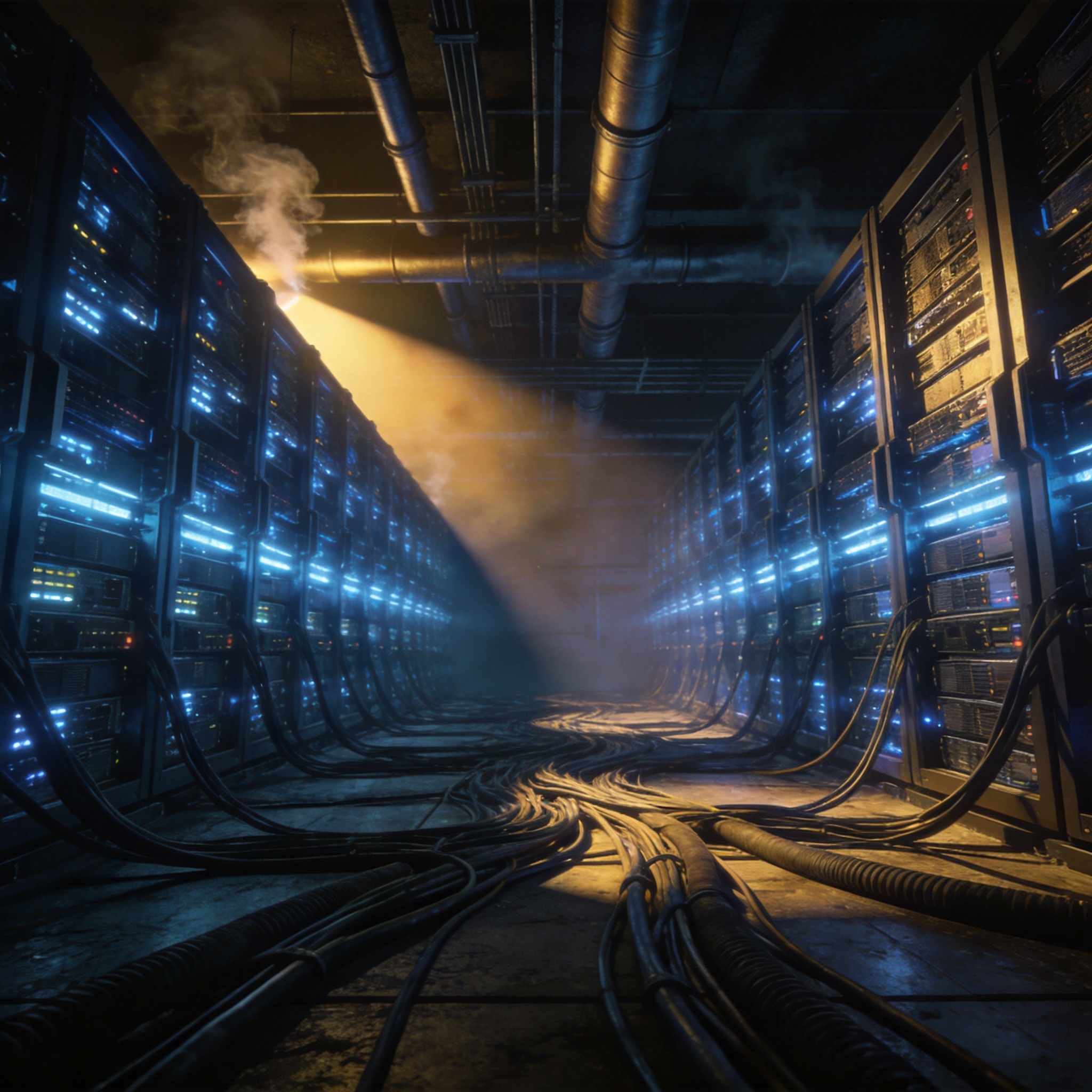
Every time you ask an AI chatbot a question, stream a movie, or back up your photos to the cloud, somewhere on Earth a massive building hums with servers, fans, and cooling systems drawing extraordinary amounts of electricity. You cannot see it. You cannot hear it. But it is happening — relentlessly, at planetary scale. The infrastructure powering our digital lives is among the fastest-growing sources of energy consumption on the planet, and the environmental bill is coming due far sooner than most people realize.
The Invisible Machine Beneath the Cloud
The cloud is, of course, not a cloud at all. It is concrete and steel. It is rows upon rows of servers stacked in buildings the size of aircraft hangars, kept cool by industrial chillers running around the clock. These are data centers — and there are thousands of them scattered across every continent, quietly consuming power on a scale that rivals entire nations.
The numbers are staggering. According to research highlighted by MIT News, global data center electricity consumption is expected to approach 1,050 terawatt-hours by 2026 — a figure that would push the sector to become the fifth-largest electricity consumer in the world 4. To frame that differently: that is roughly equivalent to the entire annual electricity output of Japan. And the trajectory is only steepening.
What makes this particularly alarming is the acceleration driven by artificial intelligence. The generative AI boom — ChatGPT, Gemini, Midjourney, and their growing list of competitors — has supercharged demand in ways that earlier forecasts simply did not anticipate. A report from The Sustainable Agency notes that by 2028, data center emissions are projected to double, potentially reaching around one percent of all global carbon emissions 6. That may sound modest in percentage terms. It is not. One percent of global emissions is an enormous, civilization-scale number.
Yet most users remain entirely unaware. The abstraction of "the cloud" is a masterpiece of technological branding — it suggests something weightless, ephemeral, clean. The reality is a sprawling physical infrastructure with a carbon footprint that Deloitte has described as deeply underreported in corporate sustainability disclosures 22. Hidden emissions from cloud computing, experts warned as far back as COP27, pose a genuine threat to net-zero targets 15. Years later, that warning has only grown more urgent.
Part of the problem is structural opacity. Tech companies have historically been reluctant to publish granular energy consumption data. When they do report, the metrics are often aggregated, cherry-picked, or offset by renewable energy purchasing agreements that critics argue obscure the true grid-level impact. The result is a sector whose environmental footprint remains, for most of the public, almost entirely invisible.
---

"The abstraction of "the cloud" is a masterpiece of technological branding — it suggests something weightless, ephemeral, clean. The reality is a sprawling physical infrastructure with a carbon footprint that remains almost entirely invisible."
Water, Watts, and the Communities Left Behind

Energy consumption is only the beginning of the environmental ledger. Data centers are also extraordinary consumers of water — millions of gallons per day, used primarily to cool the servers that would otherwise overheat and fail. This demand is increasingly placing data center operators in direct conflict with the communities that host them.
Shaolei Ren, a computer engineer at the University of California, Riverside, has been one of the most prominent voices documenting this collision. "The environmental cost of data centers, driven by AI, is increasing really fast," Ren told Discover Magazine 5. His research has helped illuminate the water consumption dimension of the crisis, which receives far less public attention than carbon emissions despite being equally consequential in water-stressed regions.
The tension is not merely academic. Across the American Southwest, in parts of Europe, and in rapidly developing markets in Asia, communities are pushing back against the siting of new data centers near already-strained water supplies 12. Local governments are beginning to ask hard questions: Who benefits from this infrastructure? And who bears the environmental cost?
The energy side of the equation carries its own community-level consequences. A study from the Energy Policy and Innovation Center at Georgia Tech found that new data center interconnections raise wholesale electricity prices by 7.3 percent through grid congestion and marginal losses 1. In practical terms, that means ordinary households in regions hosting major data center clusters may be paying higher electricity bills to subsidize the digital ambitions of global technology corporations — a transfer of costs that has gone largely unremarked in mainstream policy debates.
Meanwhile, the land footprint of data center expansion is consuming greenfield sites at an accelerating pace. Hyperscale facilities — the enormous campuses operated by Amazon Web Services, Microsoft Azure, and Google Cloud — require not just buildings but substations, transmission upgrades, and access roads. The cumulative physical footprint is substantial, and it is growing. Net Zero Insights reports that global data center capacity is expanding at a pace that outstrips the deployment of the renewable energy needed to power it cleanly 24.
---
"Efficiency per task means little when the total number of tasks is growing exponentially — and no amount of per-unit improvement closes the gap when demand is doubling every few years."
The AI Multiplier Effect
If data centers were already a significant environmental concern before the generative AI era, artificial intelligence has transformed the challenge into something categorically different. Training a single large AI model can consume as much energy as the lifetime driving of five average American cars. Inference — the process of actually running an AI model to answer your questions — adds up cumulatively across billions of daily interactions into an energy demand that is difficult to fully comprehend.
The Sustainable Agency estimates that AI systems alone could be responsible for between 32.6 and 79.7 million tons of CO₂ emissions annually by 2025 6. To put that in context, the lower bound of that range is roughly equivalent to the annual emissions of a mid-sized industrialized nation. The AI boom, the organization notes, released roughly as much CO₂ into the atmosphere as New York City did across an entire year 6.
Training is only part of the story. As MIT News explains, the carbon cost of generative AI is distributed across the full lifecycle of a model: the manufacturing of specialized chips, the construction of data centers, the ongoing energy draw of inference, and the water consumed in cooling 4. Each of these phases carries its own environmental burden, and they compound one another.
There is also the issue of rebound effects. When technology becomes more efficient, history shows that consumption tends to rise to fill — and exceed — the efficiency gains. This dynamic, known as Jevons' Paradox, is already visible in AI. As models become faster and cheaper to run, usage explodes. More queries, more applications, more integrations into everyday software. The efficiency gains that cloud providers frequently cite in their sustainability reports are being rapidly outpaced by the sheer volume of new demand 3.
Microsoft has argued that its cloud infrastructure is between 22 and 93 percent more energy-efficient than traditional enterprise data centers 3. That claim may be true on a per-workload basis. But it tells only half the story. Efficiency per task means little when the total number of tasks is growing exponentially. The environmental math remains deeply unfavorable, and no amount of per-unit efficiency improvement closes the gap when demand is doubling every few years.
---

"The cloud is not weightless. It never was. And the sooner we reckon honestly with what it costs — in watts, in water, in carbon — the better our chances of building a digital future that does not burn the physical one to the ground."
Pathways Forward — and the Urgency of Accountability
The picture is sobering, but it is not without the possibility of meaningful change. Across the technology industry, a growing movement of engineers, policymakers, and investors is pushing for what practitioners are beginning to call GreenOps — the systematic integration of environmental metrics into cloud strategy and procurement decisions 2. The idea is straightforward: if organizations are forced to see the carbon cost of their cloud usage alongside the financial cost, behavior changes.
The United Nations Environment Programme has called for binding disclosure requirements, greater investment in low-carbon cooling technologies, and a fundamental rethinking of how AI models are designed and deployed 11. Smaller, more efficient models — trained with deliberate attention to energy consumption — can deliver much of the practical utility of their larger counterparts at a fraction of the environmental cost. Researchers at institutions including NYU are actively working to build the measurement frameworks needed to make these trade-offs visible and actionable 12.
On the energy supply side, the transition to genuinely clean power for data centers is technically feasible but politically and logistically complex. Renewable energy purchasing agreements, long the industry's preferred tool for claiming carbon neutrality, are increasingly criticized by climate scientists and policy experts as insufficient. What is needed, experts argue, is time-matched, location-matched clean energy — meaning data centers powered by renewable electricity generated in the same place, at the same hour, that the servers are running. A handful of leading operators are moving toward this standard, but the industry as a whole remains far behind 19.
Regulation is beginning to catch up. The European Union's Energy Efficiency Directive now includes specific provisions for data centers, requiring operators to report energy consumption, water usage, and renewable energy sourcing in standardized formats 18. Similar frameworks are under discussion in the United States and the United Kingdom. The question is whether they will arrive quickly enough to matter.
There is also a role for individuals — not in the exhausting, individualist framing of personal carbon footprints, but in the collective sense of demanding transparency. Consumers, investors, and enterprise customers all have leverage they have barely begun to exercise. The technology companies building this infrastructure are acutely sensitive to reputational risk. Sustained, informed pressure works.
The cloud is not weightless. It never was. And the sooner we reckon honestly with what it costs — in watts, in water, in carbon, in community — the better our chances of building a digital future that does not burn the physical one to the ground.
---