
For years, quantum computing has occupied a peculiar space in the technology landscape — simultaneously the most exciting and most overpromised frontier in modern science. Executives invoke it in earnings calls. Governments pour billions into national programs. Stock prices swing wildly on a single press release. But in 2026, something has quietly shifted. The industry is no longer just talking about what quantum computers might someday do. Engineers are wrestling, in real laboratories and real data centers, with what they can do right now — and the answer is more nuanced, more fascinating, and considerably more humbling than the hype ever suggested.
From Moonshots to Milestones — What's Actually Working
The story of quantum computing in 2026 is, above all else, a story about engineering discipline finally catching up to theoretical ambition. After years of headline-grabbing proclamations about quantum supremacy, the industry has entered what analysts at The Quantum Insider describe as a phase of "sharper competition, faster technical progress, and a more sober understanding" of what these machines can realistically achieve 4. That sobriety, it turns out, is not a retreat. It is a maturation.
The gold standard architecture of the moment is hybrid quantum-classical computing — a pragmatic middle ground where quantum processors handle only the most computationally intensive subroutines while classical supercomputers manage everything else 2. This is not a consolation prize. It is a genuine, working paradigm that has allowed early adopters in finance, logistics, and pharmaceuticals to begin extracting value from quantum systems without waiting for fault-tolerant, fully universal quantum computers, which remain years away.
IBM's roadmap continues to serve as one of the most closely watched indicators of the field's velocity. The company has been methodically scaling qubit counts and, more importantly, improving qubit quality — a distinction that matters enormously. Raw qubit numbers are a marketing metric; error rates and coherence times are the engineering metrics that actually determine whether a quantum computer can solve anything useful 1. In 2026, the industry-wide push toward error correction has become the defining technical challenge, and progress, while real, is incremental rather than revolutionary.
Quantum Circuits, Inc. has highlighted that the field is advancing with tangible momentum, noting that NVIDIA's announcement of dedicated Quantum Computing Centers signals that the classical computing establishment is now treating quantum as a serious infrastructure investment rather than a research curiosity 5. When the world's largest chip company starts building quantum integration frameworks, the technology has crossed a threshold that no amount of skepticism can easily dismiss.
Yet for every genuine milestone, there remains a thick layer of promotional noise. Investor presentations still routinely conflate near-term, noisy intermediate-scale quantum devices — known in the field as NISQ machines — with the fault-tolerant systems that would be needed to crack encryption or simulate molecular biology at scale. The gap between those two categories is not a software update. It is, potentially, a decade of hard physics.

"The quantum computing industry in 2026 has stopped asking what these machines might someday do — and started reckoning, honestly, with what they can do right now."
The Investment Reckoning — Where the Money Flows and Why

The financial narrative around quantum computing in 2026 is experiencing a correction that was, by most serious assessments, long overdue. After a speculative frenzy that sent quantum-adjacent stocks soaring on the back of breathless media coverage and visionary roadmaps, the market has grown measurably more discerning 9. Analysts at The Motley Fool predicted early in the year that quantum computing hype stocks would continue to fade as institutional investors demand concrete revenue milestones rather than theoretical capability benchmarks 9.
This cooling is not uniform, however, and that distinction matters. Pure-play quantum hardware companies with vague commercialization timelines are facing the most pressure. Meanwhile, companies demonstrating actual customer engagements — paid pilots, enterprise contracts, and measurable optimization results — are finding that the investment community still has an appetite for credible quantum stories 3. D-Wave, which has leaned into near-term quantum annealing applications for logistics and materials science, has been among the more vocal proponents of a "quantum-ready" enterprise mindset, publishing predictions that 2026 would see real-world metrics finally begin separating legitimate players from aspirational ones 15.
Government investment remains a powerful counterweight to private market volatility. The United States, China, the European Union, and the United Kingdom have all committed multi-billion-dollar national quantum initiatives that insulate core research programs from the fluctuations of quarterly earnings sentiment. According to reporting from Forbes and industry analyst Bernard Marr, cryptographic security concerns — particularly the looming threat that sufficiently powerful quantum computers pose to current encryption standards — have elevated quantum investment to the level of national security strategy 13. This is not abstract. The U.S. National Institute of Standards and Technology finalized its first post-quantum cryptographic standards in 2024, and enterprises are now under active pressure to begin migration planning 8.
The IDTechEx market research firm projects the quantum computing market on a trajectory toward significant commercial scale by the early 2030s, though near-term revenue remains concentrated in cloud-based quantum access services rather than on-premise hardware sales 22. IBM, Google, Amazon, and Microsoft all offer quantum computing as a cloud service today, allowing enterprises to experiment without the prohibitive cost of owning cryogenic hardware. That access model is, quietly, one of the most important commercial developments in the field — it has democratized experimentation in a way that accelerates the discovery of real use cases.
"The dreamers have been tempered. The engineers have taken over. And the result may ultimately prove more durable than anyone's original forecast dared to suggest."
The Sectors on the Front Lines — Who Stands to Gain First
Not every industry will feel the quantum impact on the same timeline, and understanding that differentiation is essential for separating genuine near-term opportunity from long-horizon speculation. In 2026, three sectors stand clearly ahead of the pack: financial services, pharmaceuticals, and cybersecurity. Each has a specific, well-defined computational problem that quantum approaches could plausibly address before full fault tolerance is achieved.
In finance, portfolio optimization and risk modeling involve combinatorial calculations that scale exponentially with classical computers. Quantum annealing and variational quantum algorithms are already being tested by major banks and hedge funds for exactly these workloads 1. The results are not yet definitively better than classical alternatives, but the experiments are real, the data is accumulating, and the competitive pressure to be quantum-ready is intensifying. JPMorgan Chase and Goldman Sachs have both disclosed active quantum research programs, treating the technology as a strategic capability to develop now rather than license later.
Drug discovery presents perhaps the most compelling long-term case. Simulating molecular interactions at the quantum level — the actual physics of how proteins fold and how drug compounds bind — is a problem that classical computers handle only approximately, and those approximations have real costs in failed clinical trials and missed therapeutic insights 24. Quantum simulation could, in principle, model these interactions with native precision. In practice, the qubit counts and error rates required for meaningful pharmaceutical simulation still exceed current hardware by roughly one to two orders of magnitude. But the direction of travel is clear, and companies like Pfizer and Roche have established quantum partnerships precisely because the lead times in drug development demand that investment begin long before the technology fully matures.
Cybersecurity occupies a dual role in the quantum story — it is simultaneously a threat vector and an application domain. The cryptographic threat posed by quantum computers to RSA and elliptic curve encryption is well-documented, and the urgency of post-quantum cryptography migration is now a boardroom-level conversation 8. According to LinkedIn technology strategist Bob Carver, with AI adoption accelerating and cryptographic risks increasing, the transition to quantum-safe encryption "is no longer theoretical — it becomes a strategic imperative" 8. That imperative is driving a parallel boom in quantum-safe security products that represents real, immediate revenue, even before quantum computers themselves become commercially dominant.
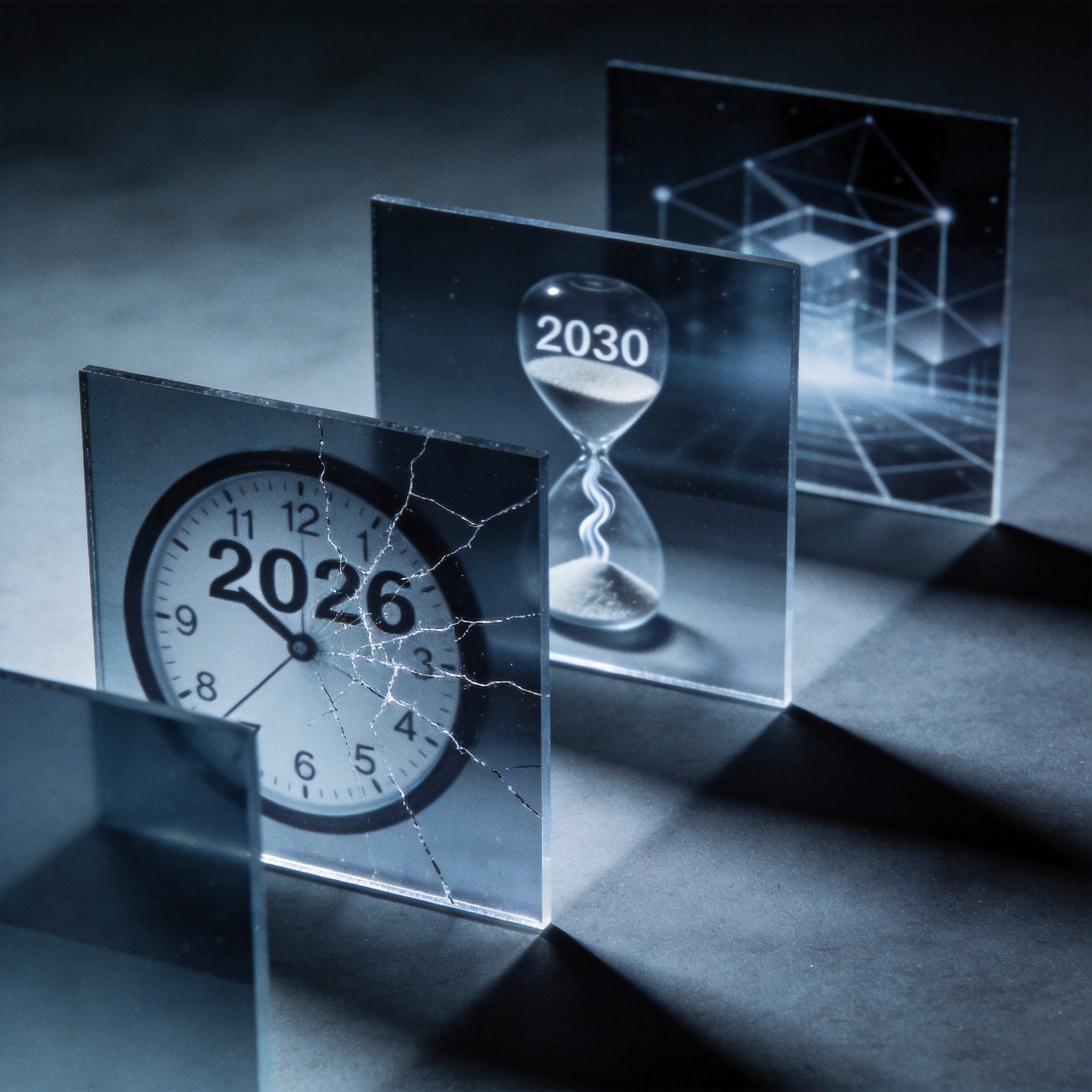
"Quantum's transition from hype to hard engineering is not a defeat — it is the only path that has ever led a transformative technology to the finish line."
The Honest Timeline — What 2026 Tells Us About 2030 and Beyond
If 2026 has delivered one overarching lesson to the quantum computing industry, it is this: the technology is real, the progress is genuine, but the timelines were — and in many cases still are — wildly optimistic. Juniper Research, in its analysis of commercial quantum computing prospects, concluded plainly that "commercialisation remains a long way off" for most enterprise applications, and that no amount of well-funded enthusiasm changes the underlying physics 7. That is not pessimism. It is calibration.
The path to fault-tolerant quantum computing runs directly through the problem of quantum error correction — the ability to detect and fix errors in qubit states without destroying the quantum information being processed. Current error rates on even the best superconducting qubits remain too high for the long computation chains that commercially transformative algorithms require. Google's demonstration of below-threshold error correction with its Willow chip in late 2024 was a genuine scientific landmark, but scaling that achievement from dozens of logical qubits to the thousands needed for real-world advantage is, by the company's own estimates, still a multi-year engineering project 6.
The newsontech.asia assessment published in early 2026 captured the industry's current posture precisely: the focus has shifted "from hype to hard engineering" 6. That shift manifests in quieter press releases, more rigorous benchmarking standards, and a growing community of quantum software developers building tools that will matter when the hardware eventually catches up. It also manifests in a more honest conversation about what "quantum advantage" actually means — not the theatrical demonstration of solving a problem no one needs solved, but the practical delivery of better answers, faster, on problems that cost real money.
Gartner's 2026 technology trend analysis places quantum computing in a phase of "climbing the slope of enlightenment" on its famous hype cycle — past the peak of inflated expectations, through the trough of disillusionment, and beginning the long, productive ascent toward a plateau of productivity 14. That framing is imperfect, as all hype cycle frameworks are, but it captures something true about where the industry stands. The dreamers have been tempered. The engineers have taken over. And the result, while less cinematic than the promises of five years ago, may ultimately prove more durable and more transformative than anyone's original forecast dared to suggest.