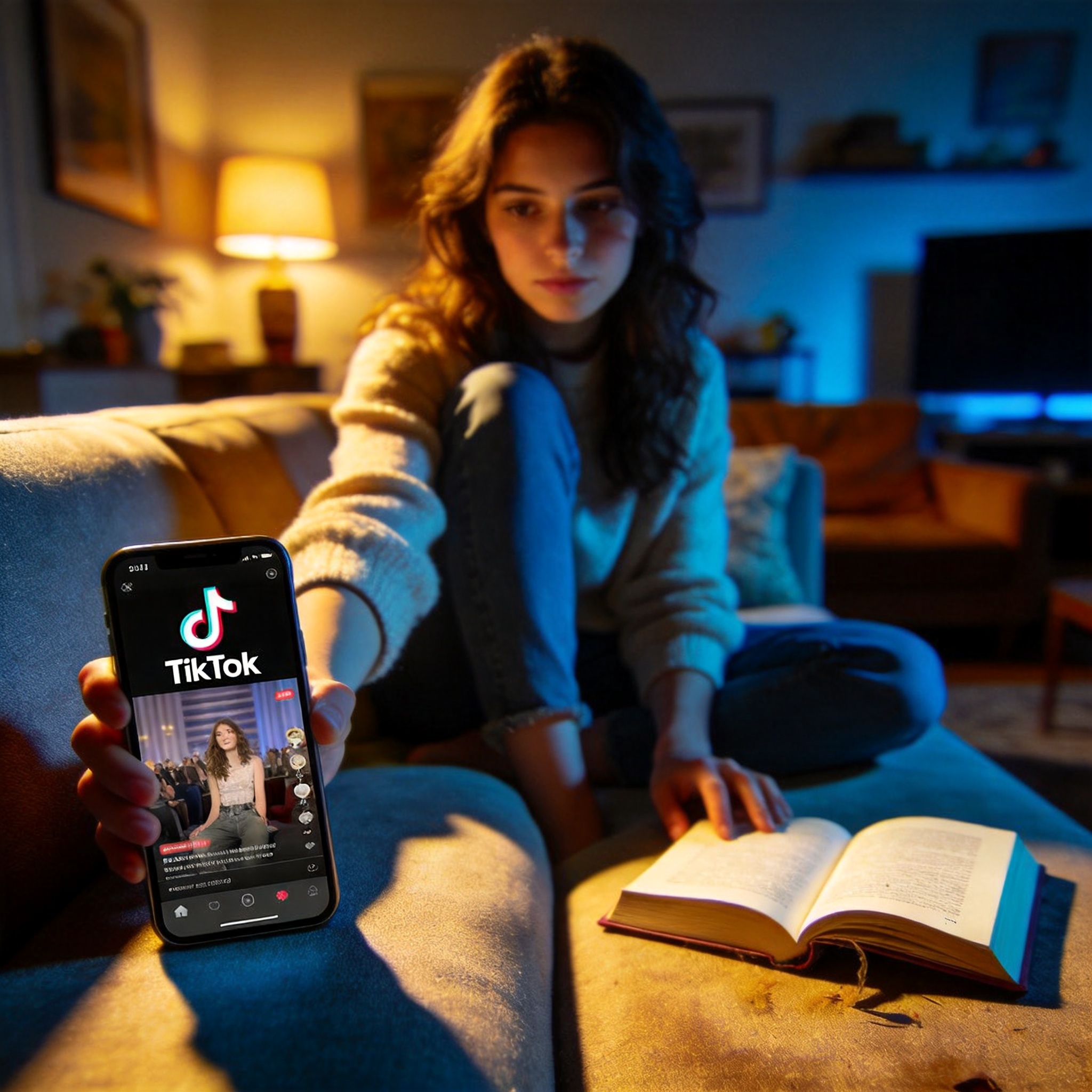
Picture a teenager on a Tuesday evening. She is not reading. She is not watching a film. She is horizontal on her bed, thumb moving in a slow, rhythmic arc, consuming sixty videos in the time it might once have taken her to finish a single chapter of a novel. Each clip lasts between seven and thirty seconds. Each one demands her complete neurological surrender before discarding her and summoning the next. She is not bored. She is, in the clinical sense, the most stimulated she has ever been. And that, researchers are beginning to warn, is precisely the problem.
The Scroll That Never Ends
TikTok did not invent short-form video. But it industrialised it. Launched internationally in 2018 after ByteDance acquired Musical.ly, the platform has since grown into one of the most algorithmically sophisticated content delivery systems ever built, boasting over one billion active users worldwide 14. Its core mechanic — an endless vertical feed of videos calibrated to individual preference with unnerving precision — has not merely changed how people consume content. It has changed what they expect content to feel like.
The numbers are striking. In a single fifteen-minute scrolling session, a teenager may consume up to sixty different videos, each demanding a complete cognitive reset — a new face, a new topic, a new emotional register 2. The brain, researchers argue, is not built for this. It is being asked to sprint continuously, with no invitation to walk. The result is a kind of low-grade mental exhaustion that paradoxically feels like engagement.
Nearly fifty percent of TikTok users surveyed by the platform itself admitted that videos longer than one minute felt "stressful" 1. Read that sentence again. Not boring. Not uninteresting. Stressful. A sixty-second video — the length of a television advertisement from the 1990s — has become, for a significant portion of the platform's audience, an endurance test. This is not a quirk of personal preference. It is a measurable shift in the baseline of human patience.
Brands have noticed. In Australia, marketers have begun fundamentally restructuring their advertising strategies in response to what industry insiders are calling "TikTok brain" — the condition whereby audiences disengage within the first two to three seconds of any content that fails to deliver an immediate hook 16. The pressure this places on storytelling is immense. Nuance, context, and complexity — the very architecture of meaningful communication — are being quietly stripped away, not by censors, but by the clock.
---

"Nearly fifty percent of TikTok's own users report that videos longer than one minute feel stressful — not boring, not slow, but genuinely stressful."
What the Science Actually Says
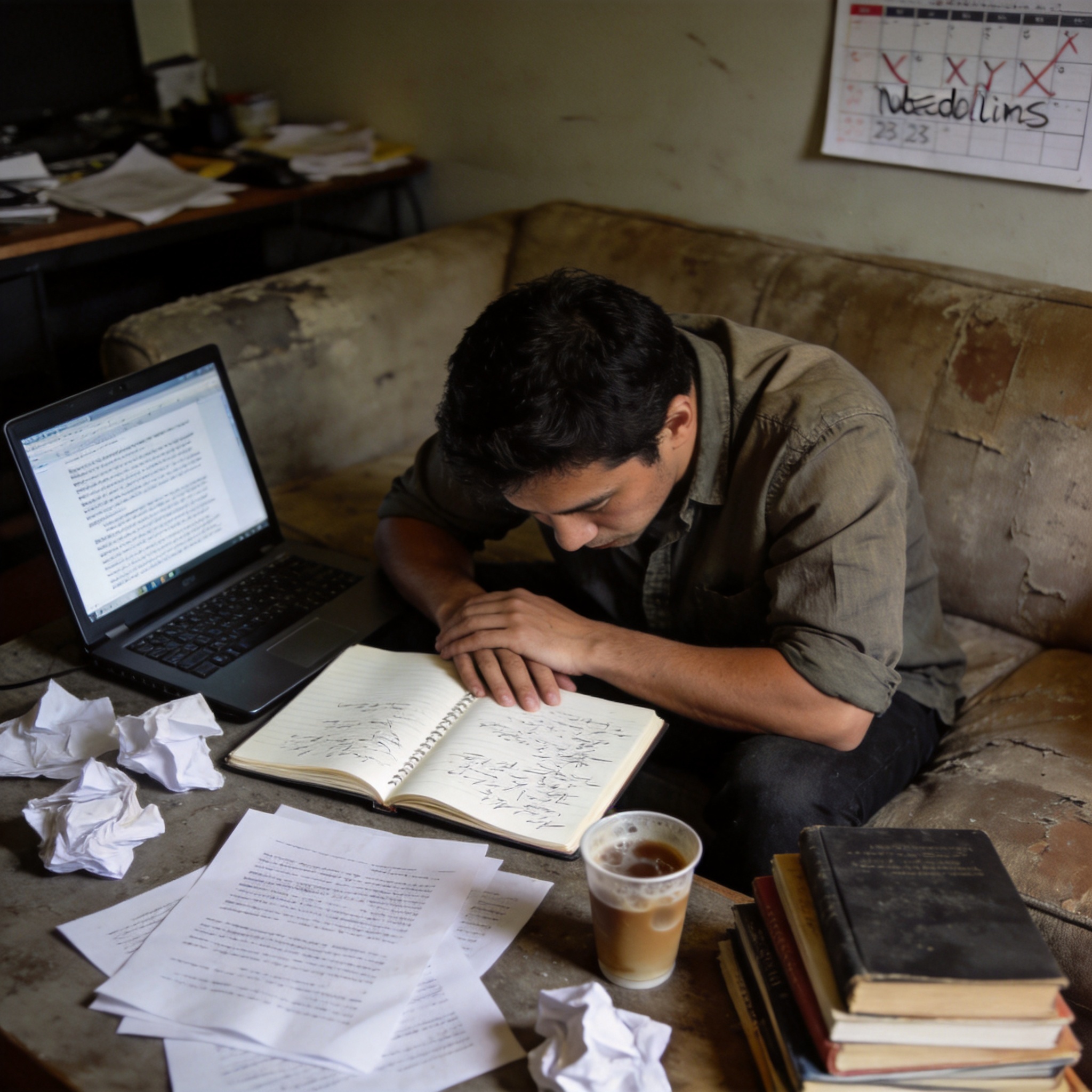
The American Psychological Association has entered the conversation with considerable force. New research cited by the APA found that people who spend extended periods consuming short-form video demonstrate measurably weaker performance on cognitive tasks requiring sustained concentration 4. This is not a moral panic dressed in scientific language. It is peer-reviewed evidence that the format is doing something real to the brain — something that extends well beyond the screen.
The mechanism, neuroscientists suggest, is rooted in dopamine. Each new TikTok video delivers a micro-reward — a flash of novelty, a burst of amusement, a jolt of surprise. The brain, which is fundamentally a prediction and reward machine, learns quickly. It begins to anticipate these micro-rewards. It begins to demand them. Activities that do not provide them — reading a long-form article, watching a documentary, sitting through a university lecture — register not as neutral but as actively unsatisfying 10. The bar for stimulation has been raised. Everything else feels like silence.
Research published through Stanford University's academic journals has explored how TikTok's algorithm functions less like a search engine and more like a slot machine, delivering variable rewards at variable intervals — the precise psychological mechanism that makes gambling so difficult to stop 21. The comparison is not hyperbolic. It is structural. And the consequences are structural too.
A study analysing data from 1,346 adolescents found that it was not screen time per se that correlated with elevated rates of depression and anxiety, but addictive patterns of use — the compulsive, joyless scroll that continues not because the user is enjoying themselves but because stopping feels worse 9. Chronic TikTok use was specifically linked to higher rates of both conditions in users under the age of twenty-four 9. These are not abstract statistics. They are portraits of a generation whose relationship with stillness is being fundamentally renegotiated without their knowledge or consent.
---
"The brain is being asked to sprint continuously, with no invitation to walk — and what looks like engagement is, increasingly, a form of exhaustion."
The Long-Form Casualties
Consider what is being lost. The novel. The essay. The two-hour film that builds slowly toward a catharsis you did not see coming. The podcast that rewards forty minutes of attention with a genuinely changed perspective. These are not relics of an arbitrary cultural preference. They are the formats through which human beings have historically processed complexity, developed empathy, and sustained the kind of deep focus that produces original thought.
Pew Research Center data from 2026 reveals that forty-three percent of American adults between the ages of eighteen and twenty-nine now regularly get their news from TikTok 7. For a cohort increasingly shaped by the platform's rhythms, this means that their understanding of war, climate change, economic policy, and public health is being filtered through a format that rewards simplicity, outrage, and speed. The consequences for democratic discourse are difficult to overstate.
Long-form journalism is feeling the pressure acutely. Editors at major publications report declining completion rates on articles over a thousand words, even among readers who clicked willingly and expressed genuine interest in the subject 8. The attention is there at the start. It simply does not hold. Publishers have responded by shortening sentences, adding more subheadings, breaking arguments into bullet points — structural concessions to a readership whose tolerance for sustained linear thinking is measurably contracting.
The educational sector is grappling with the same crisis. Teachers across multiple countries report that students who were once capable of reading a chapter independently now struggle to maintain focus for more than ten minutes without reaching for their phones 22. University lecturers describe the peculiar experience of watching auditoriums full of young adults who are physically present but cognitively somewhere else entirely — somewhere faster, louder, and more immediately rewarding. The long-form lecture, once the cornerstone of higher education, is being quietly redesigned around an attention span that TikTok helped to shrink.
Meanwhile, Gen Z's relationship with TikTok itself shows signs of evolution. Adobe Express data from 2026 shows that Gen Z's preference for using TikTok over Google as a search tool dropped from eight percent to four percent in just two years 6 — suggesting that even the platform's most devoted users may be sensing, somewhere beneath the scroll, that something is being taken from them.
---

"Attention, like muscle, atrophies without use; the question is whether we still have the collective will to exercise it."
Can We Reclaim the Deep Read?
The conversation about TikTok and attention is not, at its core, a conversation about a single app. It is a conversation about what kind of minds we want to inhabit — and what kind of culture we want to build with them. There are reasons for cautious optimism, though they require effort to locate.
TikTok's own 2026 trend report, titled "Irreplaceable Instinct," made a striking admission: the era of passive, dopamine-fuelled scrolling is ending 17. The report argues that users are increasingly seeking content that feels meaningful, intentional, and participatory — a signal that even within the short-form ecosystem, appetite for substance has not been entirely extinguished. Whether the platform's architecture can genuinely accommodate depth, or whether this is sophisticated marketing language, remains to be seen.
Neuroplasticity offers a more grounded source of hope. The same quality of the brain that makes it vulnerable to the attentional habits TikTok cultivates also makes it capable of recovery. Researchers and educators are increasingly advocating for what some call "attention hygiene" — deliberate, structured practices designed to rebuild the capacity for sustained focus. These include timed reading sessions without devices, the reintroduction of physical books into daily life, and media literacy education that teaches young people to recognise the mechanisms through which their attention is being harvested 3.
Some creators are pushing back from within the platform itself. A growing number of educators, writers, and thinkers are using TikTok not to deliver thirty-second entertainment but to direct audiences toward longer work — treating the platform as a doorway rather than a destination. The results are uneven, but the instinct is sound. Attention, like muscle, atrophies without use and strengthens with deliberate exercise.
The deeper question is one of collective will. Platforms will not redesign themselves out of profit. Advertisers will not voluntarily surrender the fractured attention they have learned to monetise. The responsibility falls, as it so often does, on individuals, educators, and policymakers — people willing to insist that the long read, the slow film, the sustained argument, and the quiet hour are not luxuries. They are the conditions under which a thinking, feeling, democratic society remains possible.
---