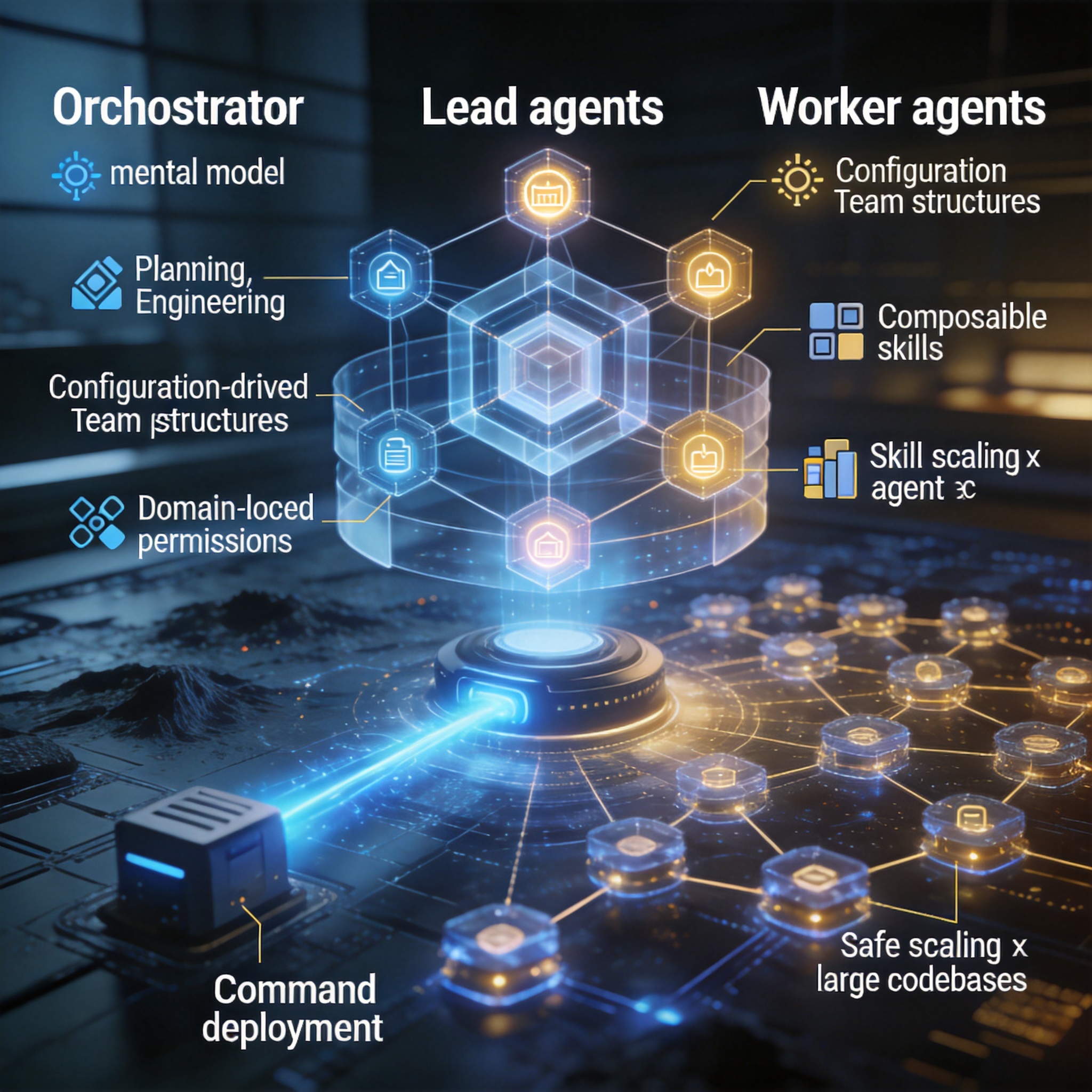
Somewhere in the guts of your next software project, a quiet revolution is taking shape — not one AI agent fumbling through a monolithic task, but an entire hierarchy of them: strategists, team leads, and specialists, each with its own memory, its own lane, and its own compounding understanding of your codebase. The architecture is deceptively simple — three layers, configuration-driven teams, one deployment command. The implications are not simple at all. This is the story of how multi-agent delegation systems are rewriting the rules of autonomous software engineering, and why the smartest teams in the industry are betting everything on them.
The Pyramid: Why Three Layers Change Everything
For years, the default approach to AI-assisted coding was the lone generalist — a single large language model asked to do everything from planning a feature to writing tests to reviewing its own output. It was like hiring one person to be architect, bricklayer, and building inspector simultaneously. The results were predictable: hallucinated logic, forgotten context, and scope collapse on anything beyond a few hundred lines. The three-layer delegation model exists because that approach hit a wall.
At the apex sits the Orchestrator agent. Its job is strategic: it receives a high-level objective — "Refactor the authentication module to support OAuth 2.1" — and decomposes it into discrete workstreams. It does not write code. It does not run tests. It thinks. As enterprise architecture researchers describe it, the Orchestrator handles "strategic coordination and task routing," deciding which teams to activate and in what sequence 1. Think of it as a program director who never touches a keyboard.
Below the Orchestrator sit the Lead agents, each commanding a specialized team: Planning, Engineering, Validation, or custom domains you define yourself. A Lead agent receives a workstream — say, "Design the token refresh flow" — and further breaks it into granular tasks for its Workers. Anthropic's own engineering team documented this pattern in their multi-agent research system, where "a lead agent coordinates the process while specialized sub-agents execute individual tasks" 6. The Lead maintains context across its team's work, resolves conflicts between Worker outputs, and reports synthesized results upward.
At the base are the Worker agents — narrow, fast, and disposable in the best sense. One Worker writes a database migration. Another drafts unit tests. A third scans for security vulnerabilities. They execute, return results, and move on. A detailed Reddit post-mortem on an autonomous DevOps system described this execution layer as the place where "specialized agents perform bounded, well-defined operations with minimal decision-making latitude" 9. The Workers don't need to understand the whole picture. That's the point. The pyramid ensures that no single agent carries more cognitive load than it can handle — and that the system as a whole remembers what each part has learned.

""The agents aren't just completing tasks. They are building a theory of your project. And that theory gets sharper every day.""
Mental Models That Compound: The Memory Advantage

The most underrated feature of this architecture is not the hierarchy. It is the memory. Each agent — Orchestrator, Lead, Worker — maintains what designers call a "mental model": a persistent, evolving representation of the project's state, conventions, past decisions, and accumulated lessons. Over the course of a project, these models compound. The Orchestrator learns which decomposition strategies produce clean results. A Lead agent learns that your team prefers repository-pattern data access. A Worker agent learns that your CI pipeline chokes on circular imports.
This is not merely caching. It is institutional knowledge encoded in silicon. Microsoft's cloud adoption framework for AI agents emphasizes that the decision between single-agent and multi-agent systems often hinges on whether the problem domain requires "accumulated context that exceeds the working memory of any individual model" 3. In large codebases — the kind with hundreds of thousands of lines, dozens of microservices, and years of architectural debt — no single context window is large enough to hold everything that matters. Distributing memory across a hierarchy solves this by letting each agent specialize in what it remembers, just as it specializes in what it does.
The compounding effect is what separates this from stateless tool-use chains. After ten tasks, the Engineering Lead doesn't just know your codebase — it knows how your codebase *evolves*. It has watched three refactors succeed and one fail. It has internalized your naming conventions not because someone wrote a style guide, but because it observed patterns across fifty file edits. TrueFoundry's analysis of production multi-agent architectures notes that "the central orchestrator agent acts as the manager agent, understanding the overall goal and breaking it into smaller, manageable sub-tasks" — but the real power emerges when that understanding persists and deepens across sessions 5. The agents aren't just completing tasks. They are building a theory of your project. And that theory gets sharper every day.
""Scale without safety is sabotage — which is why the entire framework is configuration-driven, with hard boundaries, not suggestions.""
Guardrails by Design: Permissions, Domains, and Composable Skills
Scale without safety is sabotage. The architects of three-layer delegation systems understood this from the start, which is why the entire framework is configuration-driven — teams are defined in declarative files, not hard-coded into the system. You specify which teams exist (Planning, Engineering, Validation, or your own custom squads), what skills each team can invoke, and critically, what each team *cannot touch*.
Domain-locked permissions are the architectural equivalent of a firewall between departments. The Validation team can read source files and execute test suites, but it cannot modify production code. The Engineering team can write to source directories but cannot alter deployment configurations. The Orchestrator can delegate to any Lead, but it cannot bypass a Lead to issue commands directly to Workers. Credal's guide to multi-agent platforms underscores that a well-designed orchestrator "decides how agents interact, passes context between them, and enforces governance rules" — and governance, in this context, means hard boundaries, not suggestions 7.
Composable skills add another layer of control and flexibility. Rather than granting an agent blanket access to "write code," you assign it discrete capabilities: `generate_migration`, `run_linter`, `query_api_docs`. Skills can be shared across teams or restricted to one. They can be versioned. They can be audited. This composability means you can onboard a new team — say, a Documentation squad — without rewriting the system. You define its skills, set its permissions, lock its domain, and the Orchestrator learns to route relevant tasks to it. The Turing College guide to Claude's Agent Teams architecture describes this as a shift from "one generalist AI handling an entire task" to modular, permission-bounded specialists that can be assembled and reassembled as project needs change 8. The result is a system that scales not by adding raw power, but by adding *structure* — the same way a well-run engineering organization scales by hiring into defined roles, not by cloning its best developer.

""The lone-wolf AI agent, brilliant but brittle, is giving way to something that looks suspiciously like an organization.""
One Command to Rule Them: Deployment and the Road Ahead
The final promise — and the one that converts skeptics into believers — is deployment simplicity. A three-layer multi-agent delegation system, for all its internal complexity, is designed to drop into any project with a single command. One CLI invocation reads your configuration files, spins up the Orchestrator, instantiates the Lead agents and their Worker pools, connects to your repository, and begins work. No bespoke infrastructure. No month-long integration. The system meets your codebase where it lives.
This matters because adoption friction kills architectures that are theoretically superior. The history of software tooling is littered with elegant systems that nobody used because setup took a week. The one-command deployment model borrows from the DevOps playbook — containerized, declarative, idempotent — and applies it to agent orchestration. A detailed analysis of hierarchical agent systems notes that the most successful deployments treat agent configuration as infrastructure-as-code, versioned alongside the project it serves 9. Your agent team definition lives in your repo. It evolves with your code. It is reviewable in a pull request.
But the road ahead is not without hazards. As organizations push these systems toward larger codebases and more autonomous operation, the questions multiply. How do you audit an Orchestrator's decomposition decisions at scale? What happens when two Lead agents' mental models diverge on a foundational assumption? How do you debug a failure that cascades across three layers of delegation? Microsoft's framework acknowledges that multi-agent systems introduce "coordination overhead and emergent behavior that requires careful monitoring" 3. The tooling for observability — tracing a single decision from Orchestrator intent through Lead coordination to Worker execution — is still maturing.
Yet the trajectory is unmistakable. The lone-wolf AI agent, brilliant but brittle, is giving way to something that looks suspiciously like an organization: layered, specialized, memory-rich, and governed by rules its creators can actually read. The teams that master this architecture won't just ship code faster. They will have built something that learns their craft — and practices it while they sleep.