Imagine submitting a single strategic question — say, whether to enter a new market or restructure a supply chain — and receiving back not a chatbot's best guess, but a structured executive memo forged through rigorous debate among a dozen specialized minds. No scheduling conflicts. No egos. No groupthink. That is the promise of CEO Agents, a new class of multi-agent AI system that orchestrates a virtual boardroom of expert advisors, each powered by large language models, each arguing from a distinct vantage point, and each accountable to a central orchestrator whose sole job is to synthesize their collective intelligence into something a human leader can actually act on.
The Boardroom in the Machine
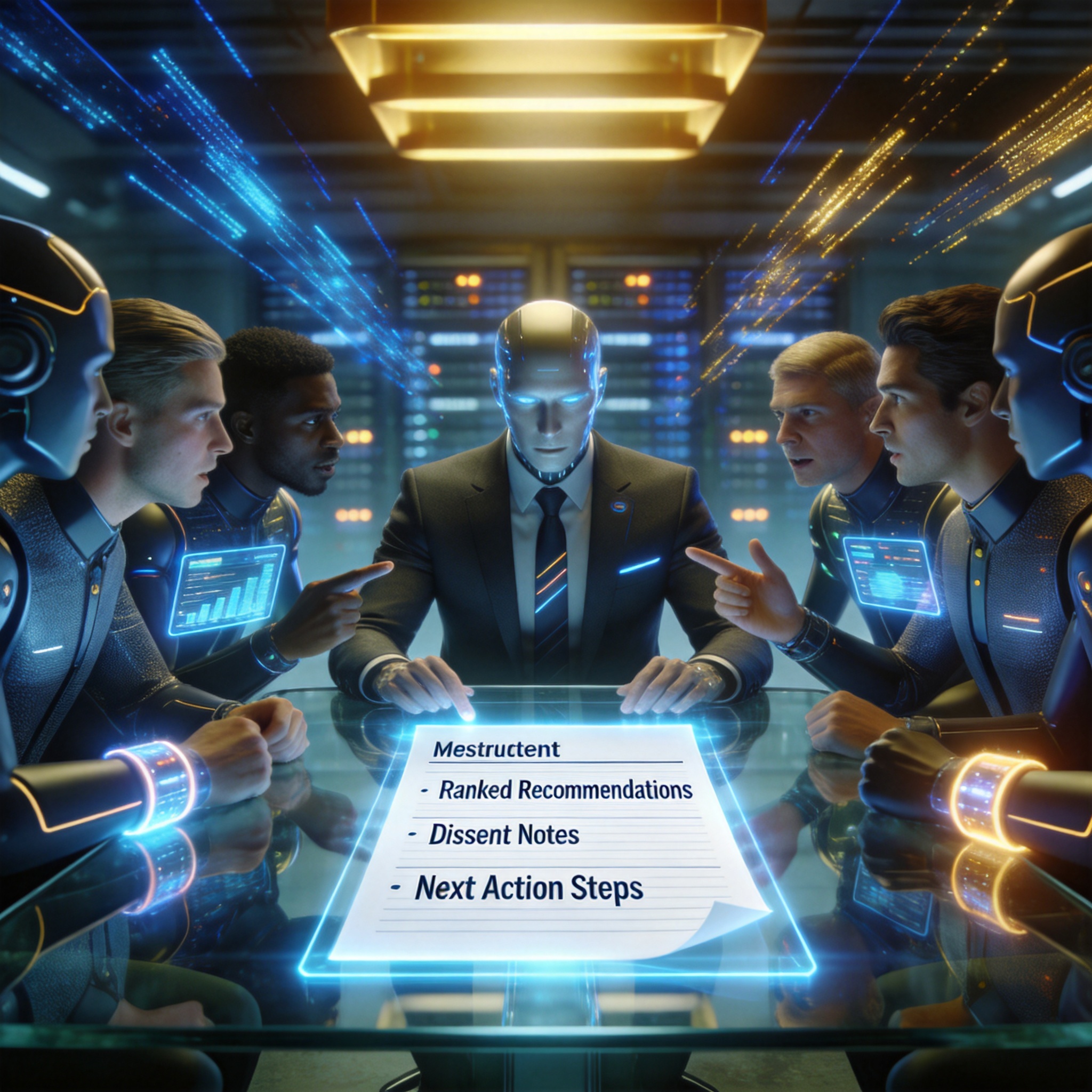
The concept is deceptively simple. You draft a brief — a prompt articulating a strategic question, a market dilemma, or an operational challenge — and hand it to a CEO agent. That agent does not answer the question itself. Instead, it convenes a panel of custom-built advisor agents, each assigned a specialized role: a chief financial analyst who stress-tests margins, a market strategist who maps competitive landscapes, a risk officer who hunts for downside scenarios, a legal mind who flags regulatory exposure, and perhaps a contrarian whose explicit mandate is to disagree with the emerging consensus. These agents then engage in structured, multi-round deliberation — debating, challenging, refining — until they converge on a set of ranked recommendations delivered as a formal memo complete with areas of dissent and concrete next actions.
This architecture mirrors what researchers call "multi-agent debate," a pattern in which multiple independent LLM-powered agents collaborate and compete on a task by discussing it among themselves until they reach alignment 1. The approach is not merely theoretical. A 2025 paper published through the Association for Computational Linguistics found that the choice of decision-making protocol — whether agents vote, reach consensus, or employ hybrid methods — materially affects the quality of outcomes, with consensus-driven protocols consistently outperforming simple majority voting on complex reasoning tasks 5.
What makes the CEO Agent framework distinct from a generic multi-agent pipeline is its deliberate emulation of corporate governance. Traditional single-agent systems, even sophisticated ones, produce a single perspective — one voice, one set of biases, one blind spot. A multi-agent system organized as a board of advisors introduces institutional friction by design. As one recent architecture paper from arXiv put it, coherence emerges not from a single brilliant agent but from orchestrating "a team of rivals" — specialized agent teams including planners, executors, critics, and domain experts organized into structured hierarchies 3. The friction is the feature. Disagreement surfaces assumptions that a lone model would silently embed in its answer.

""The friction is the feature. Disagreement surfaces assumptions that a lone model would silently embed in its answer.""
How the Debate Actually Works

Beneath the boardroom metaphor lies a carefully engineered orchestration layer. Multi-agent orchestration, as defined by practitioners at Talkdesk, is the process of coordinating multiple AI agents to work together in a structured, goal-oriented way, where rather than relying on a single monolithic model, the system decomposes problems and routes subtasks to the agents best equipped to handle them 6. In the CEO Agent paradigm, the orchestrator — the CEO agent itself — manages turn-taking, enforces argumentation norms, and determines when sufficient convergence has been reached to draft the final memo.
Each round of debate follows a rhythm. An advisor agent states its position, marshaling evidence and reasoning. Other agents respond, either reinforcing the argument, introducing countervailing data, or exposing logical gaps. The CEO agent monitors the exchange for signs of convergence or irreconcilable dissent. When consensus forms around a recommendation, it is logged and ranked. When genuine disagreement persists, it is preserved in the memo's dissent section — a feature that many human executive teams would envy.
This is not a free-for-all. Coordination strategies matter enormously. Research from the Cooperative AI Foundation, as reported by Galileo AI, indicates that multi-agent systems present amplified risks compared to single agents when coordination breaks down — cascading errors, contradictory outputs, and resource deadlocks can all derail an unmanaged system 7. Effective CEO Agent implementations mitigate these risks through strict role definitions, bounded communication channels, and explicit termination conditions that prevent debates from spiraling into infinite loops. ZenML's documentation on enterprise decision-support architectures describes systems where specialized AI agents collaborate to analyze decision documents, surface risks, and challenge assumptions within tightly governed workflows 8. The discipline imposed by the orchestration layer is what transforms a collection of language models into something resembling institutional intelligence.
""Every advisor agent is given equal computational resources, equal speaking time, and zero career anxiety.""
Why Structured Dissent Changes Everything
The most revolutionary element of the CEO Agent output is not the consensus. It is the dissent. In traditional corporate decision-making, dissenting voices are often muted by hierarchy, social pressure, or simple time constraints. The loudest voice or the highest-ranking executive frequently carries the day, regardless of argument quality. Multi-agent systems invert this dynamic. Every advisor agent is given equal computational resources, equal speaking time, and zero career anxiety. The contrarian agent cannot be fired for disagreeing with the CFO agent.
This matters because research consistently shows that structured disagreement improves decision quality. AI agent debate systems use multi-agent collaboration to improve accuracy, reduce errors, and produce smarter decisions in complex business scenarios precisely because they surface edge cases and failure modes that homogeneous thinking would miss 4. When the final memo lands on a human decision-maker's desk, it does not merely say "do this." It says "do this, but be aware that two of your seven advisors flagged the following risks, and here is their reasoning." That transparency gives leaders something rare: a genuine map of the decision landscape, not just a single recommended path through it.
The structured memo format itself is a deliberate design choice. Ranked recommendations impose prioritization. Dissent sections preserve intellectual honesty. Next-action items translate strategic consensus into operational steps. For enterprise teams accustomed to wading through sprawling slide decks and ambiguous meeting notes, the contrast is stark. Credal's comprehensive guide to multi-agent platforms notes that the real value of coordinated AI agents lies not in any single agent's capability but in their ability to solve complex problems that a single agent simply cannot address alone 9. The CEO Agent memo is the artifact of that collective problem-solving — a document that carries the fingerprints of multiple expert perspectives, stress-tested against each other in real time.

""The marginal cost of an additional genius is measured in tokens, not salaries.""
A Country of Geniuses in a Data Center
The tagline is provocative but not hyperbolic: with CEO Agents, it is not just you or your team making critical decisions — it is you, your team, and a country of geniuses in a data center. The scalability implications are profound. A human board of directors meets quarterly. A CEO Agent board can convene in seconds, scale to dozens of specialized advisors, and run parallel deliberations on multiple strategic questions simultaneously. Need to evaluate an acquisition while simultaneously stress-testing a pricing strategy and modeling regulatory scenarios across three jurisdictions? Spin up three boards. The marginal cost of an additional genius is measured in tokens, not salaries.
But scalability without governance is chaos. IBM's research on multiagent systems emphasizes that coordination mechanisms — shared memory, communication protocols, and conflict-resolution rules — are what distinguish a functional multi-agent system from a cacophony of competing outputs 13. The most sophisticated CEO Agent implementations incorporate meta-agents: monitors that evaluate the quality of the debate itself, flagging when agents are reasoning circularly, when evidence is being fabricated through hallucination, or when the group is converging too quickly — a digital analog of groupthink detection.
The human decision-maker remains firmly in the loop. The CEO Agent system does not make decisions. It makes recommendations. The memo it produces is an input to human judgment, not a replacement for it. What changes is the richness of that input. Instead of relying on a single analyst's report or a single AI model's output, leaders receive a multi-perspectival, adversarially tested, structurally transparent synthesis of the best arguments available. The strategic question you posed to one prompt returns as a document shaped by debate, refined by dissent, and ready for action. In an era when the complexity of business decisions routinely outpaces any individual's capacity to analyze them, the notion of convening a digital boardroom on demand is not a luxury. It is rapidly becoming a necessity — and the geniuses are already waiting in the data center, ready to argue on your behalf.